


 |  |  |  |
|---|---|---|---|
 |  |  |  |
 |  |
Corks
Top-of-the-Bottle Experts
Founded in California in 1981, the Cork Supply Group has enjoyed more than three decades of growth, solidifying the company’s leading position in the North American natural cork stopper market. In addition, Cork Supply has established a superior sales and production presence in wine producing countries around the world.
Cork Supply Portugal was founded in 1995, and today the company manages three facilities in Portugal that vertically integrate natural cork production from forest to bottle. Raw corkwood is harvested from southern Portugal and Spain, transformed into premium quality natural cork stoppers and used to seal some of the world’s finest wines. In 2003, Cork Supply expanded into Europe, increasing sales throughout key wine regions, and becoming one of the largest suppliers of natural cork stoppers worldwide, suppling corks in more than 50 countries.
Choosing the Right Closure
Whichever closure you choose, you can rest assured Cork Supply will provide you the industry's finest quality product, service and support.

Top Expertise

Premium Service

Quality Solutions

Taint-free guarinteed
High performance

Superior functions and consistency

Natural Cork
Closures made from cork material come from the bark of Quercus suber, a native oak tree that grows in the Mediterranean region. Most natural cork closures are manufactured in Iberia, primarily in Portugal.
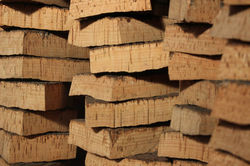
The bark is harvested every nine years from mature trees between the months of June and August. Corkwood, once aged, conditioned, and cleaned, is sliced in sections proportional to the length of the closure and punched parallel to the axis of the trunk of the tree (see drawing). Then, the corks are rectified (sanded), peroxidewashed (to whiten them), sorted by visual grades,4 and bagged in quantities of usually 10,000 corks (a bale). At this point, the corks are exported to wine-producing regions throughout the world where they are then printed, moisturized, and treated (usually with paraffin and silicone).
Technical Corks
The spent corkwood, a byproduct of the natural cork punching, is not wasted but used to manufacture “technical” corks. The material is ground and the cork granules are sorted by particle size. Through various cleaning techniques, the particles are washed to reduce or eliminate any traces of potential taint and/or other unusual aromas. The cork granules are finally glued together to make micro-agglos, 1+1s (dual disk), and champagne cork closures.
